




How to Choose Between a Hydraulic Press Brake and a Servo Press Brake?
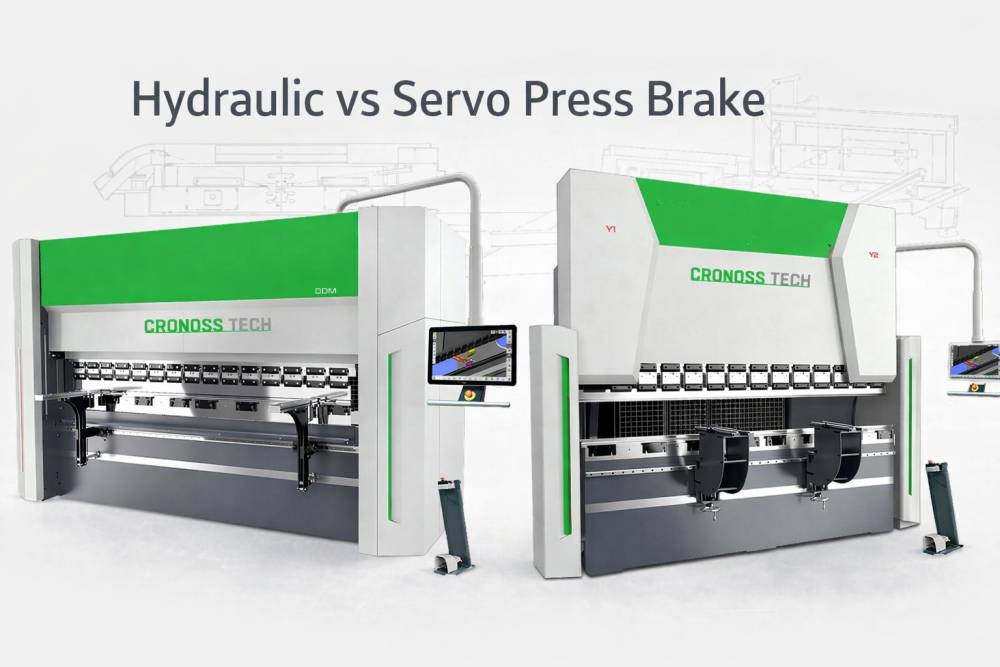
How to Choose Between a Hydraulic Press Brake and a Servo Press Brake?
23-01-2026
CRONOSSTECH Engineering Team
Choosing the right press brake technology in sheet metal forming processes is a critical decision that directly affects production efficiency, part quality, and long-term operating costs.
While hydraulic press brakes have been the industrial standard for many years, servo press brakes are increasingly preferred for specific production requirements. Each technology, however, offers distinct advantages depending on the application.
In this article, we technically compare hydraulic press brakes and servo press brakes in terms of application areas, precision, energy efficiency, production speed, and maintenance requirements.
1. Understanding the Two Technologies
Before making a comparison, it is important to understand the operating principles of both systems.
Hydraulic Press Brakes
Hydraulic press brakes generate bending force through hydraulic cylinders. The movement of the ram (upper beam) is controlled by hydraulic oil pressure and proportional valves.
These systems have been reliably used for many years, particularly in high-tonnage and thick sheet metal applications.
Servo Press Brakes
In servo press brakes, ram movement is driven directly by servo motors using ball screws or belt-driven systems. No hydraulic oil is used, and all movements are digitally controlled.
This structure provides high speed, precision, and energy efficiency.
2. Precision and Repeatability
One of the most important criteria in press brake selection is bending accuracy.
• Hydraulic press brakes offer stable and reliable precision, especially for medium- and thick-gauge sheet metal.
• Servo press brakes provide exceptionally high positioning accuracy and repeatability, particularly in thin-sheet applications.
For tight tolerances, high surface quality, and precision-critical parts, servo technology clearly stands out.
3. Energy Efficiency and Operating Costs
Today, energy consumption is a key factor in investment decisions.
• In hydraulic systems, energy consumption continues even when the machine is idle due to continuous oil circulation.
• In servo press brakes, energy is consumed only during ram movement.
As a result, servo press brakes can significantly reduce energy costs, especially in high-volume production environments.
4. Speed and Productivity
Production speed directly impacts overall capacity.
• Hydraulic press brakes perform effectively at standard production speeds and in heavy-duty applications.
• Servo press brakes offer faster approach, bending, and return speeds, reducing cycle times.
For repetitive and serial production, servo systems deliver higher productivity.
5. Maintenance Requirements and System Durability
Maintenance needs differ between the two technologies.
• Hydraulic press brakes require regular oil changes, seal inspections, and valve maintenance.
• Servo press brakes have lower maintenance requirements since they do not include hydraulic components, and there is no risk of oil leakage.
However, hydraulic systems have proven their long-term durability in harsh industrial environments.
6. Choosing the Right Technology for Your Application
The correct press brake technology depends on your production profile.
Suitable Applications for Hydraulic Press Brakes
• Thick sheet metal and high-tonnage requirements
• Heavy-duty bending operations
• Flexible, project-based production
Suitable Applications for Servo Press Brakes
• Thin and medium-gauge sheet metal
• High-precision parts
• Serial and repetitive production
• Facilities prioritizing energy efficiency
7. Conclusion: There Is No Single “Best” Solution
There is no single “best” press brake technology.
The right choice depends on a combined evaluation of material type, sheet thickness, production volume, precision requirements, and long-term operating costs.
A well-informed analysis of these factors ensures an investment that not only meets current production needs but also supports future growth.